Beans and Sardines

  • Home
  • About
  • Recipe of the week
  • Recipes
  • Wines
  • Contact
Spinach or chard with garlic and olive oil Istrian way 7.jpg

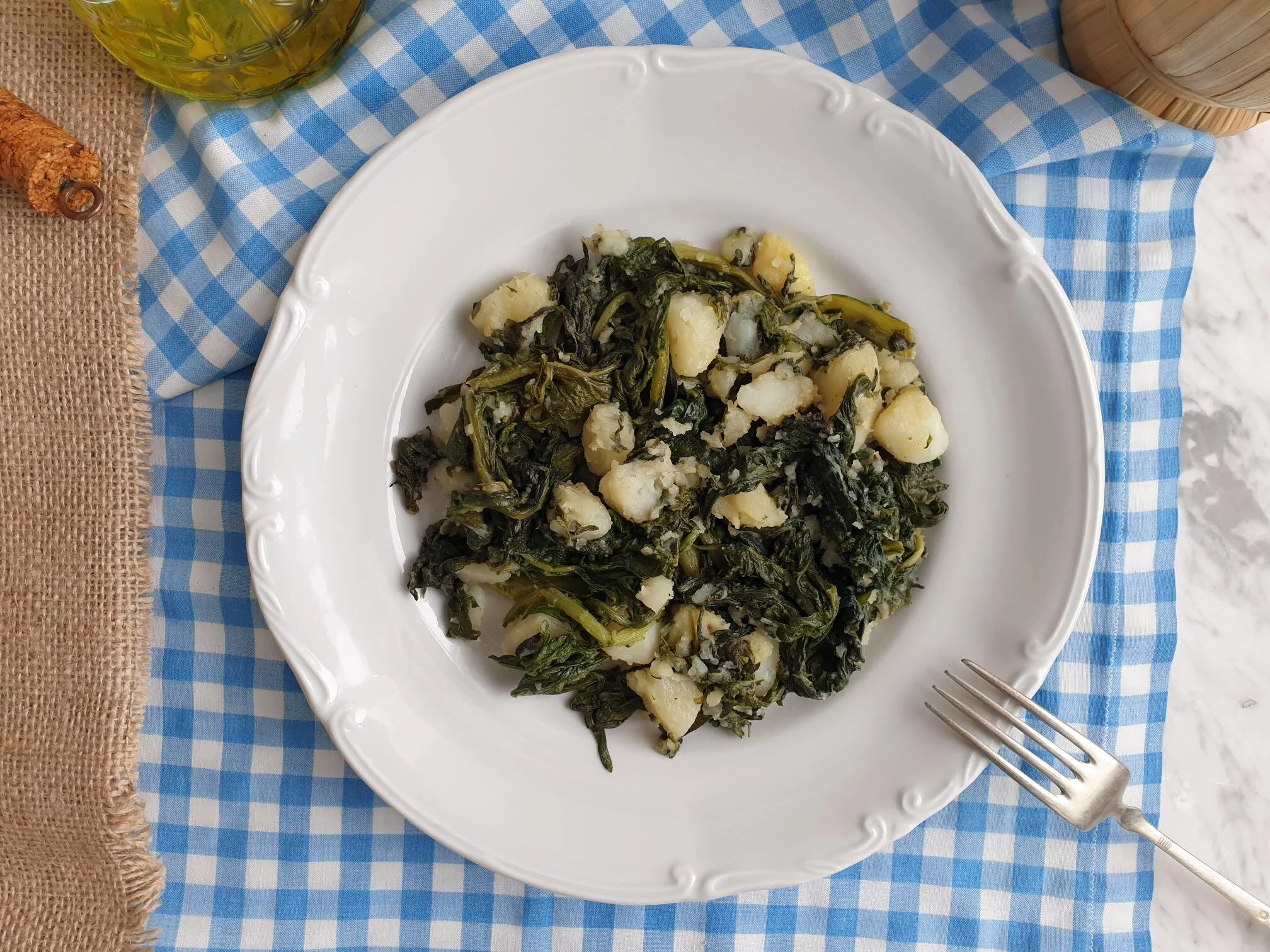
Spinach or chard with potatoes garlic and olive oil Istrian way Recipe

Beans and Sardines
October 02, 2021 by tina oblak in Adriatic Recipe, brunch, Central European recipes, Easy recipe, healthy mael, Istrian cuisine, Istrian dish, Istrian food, Istrian gastronomy, Nutritious dish, Rustic dish, Side Dishes, Slovenian cuisine, Slovenian food, Slovenian gastronomy, Vegan, Vegetarian

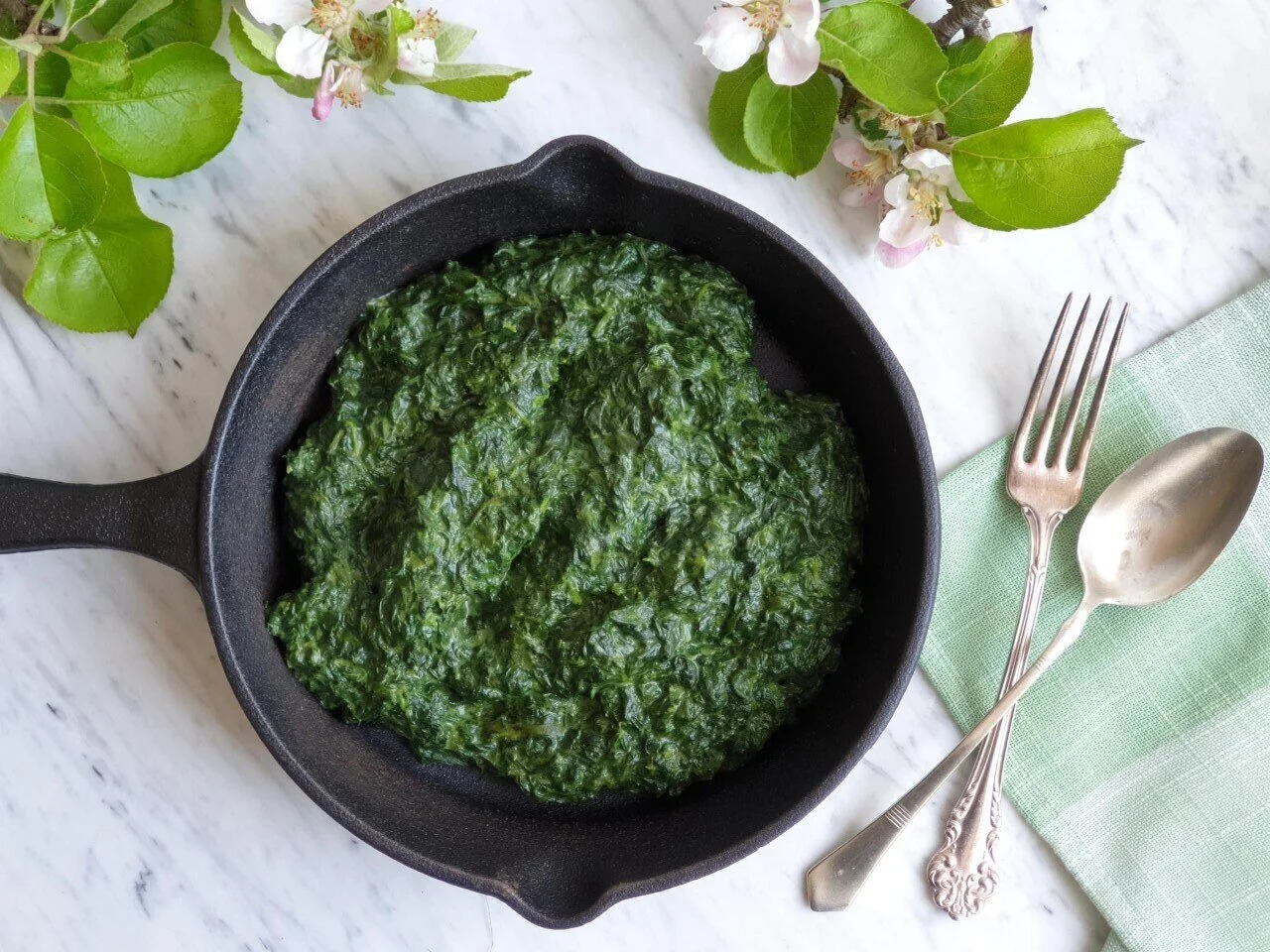
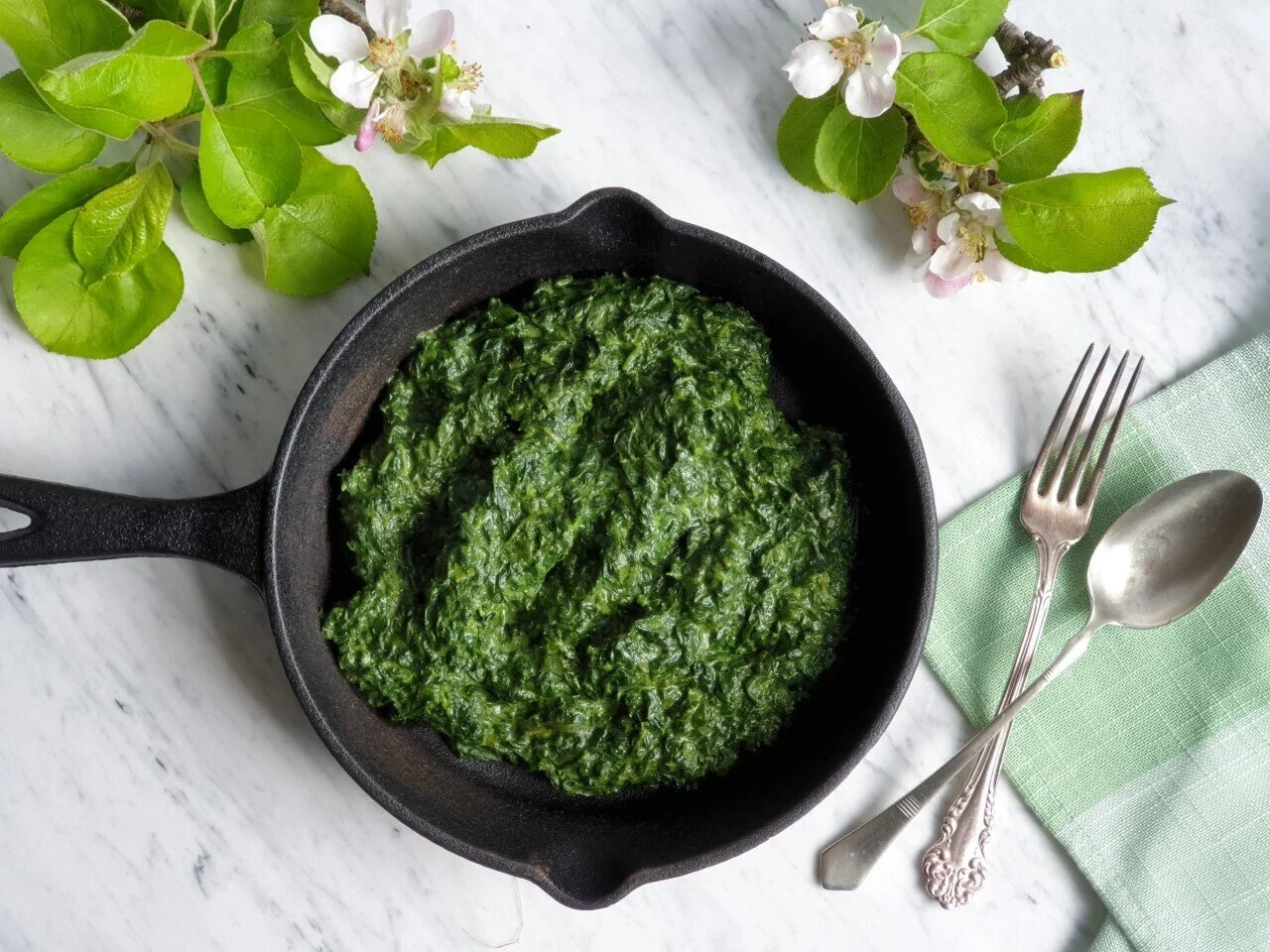
Spinach or chard with garlic and extra virgin olive oil is a peasant dish, hearty, rustic and nutritious. It is extremely easy to make, inexpensive and with its humble appearance it most certainly offers a lot more than meets the eye.

It is a perfect side dish to any grilled or fried fish, but equally delicious with pork, lamb or chicken and accompanied with fried egg makes a great vegetarian meal option.

Back home, on the Slovenian coast, this dish is a most frequent companion to grilled fish and grilled or deep fried squid, a bit like fish and chips and mushy peas in the United Kingdom.

Spinach or chard with garlic and olive oil is very popular in Dalmatia and on Dalmatian islands (Croatia) where it is believed it originated from. It is on this islands, where tomatoes, peppers, cucumbers and other summer vegetables are abundant during the summer, that chard would be the only green leaf vegetable that could grow during the scorching summer heat therefore it has been a very treasured vegetable containing a lot of vitamins and minerals and a lot of water make it very hydrating and easy to digest.

This dish travelled north along Dalmatian coastline to Istria where it has become as popular as in Dalmatia and is found on the menus in most restaurants and cooked in almost every household.

This is another dish that is part of my childhood and adulthood, it never came into the fashion, it never went out of the fashion, it has simply always been there...

I am sharing here my family recipe.

Spinach or chard with garlic and olive oil Istrian way 1.jpg

Ingredients

Serves 4-6 as part of meal

  • 1kg spinach, baby spinach or chard

  • 400-450g potatoes, peeled and cubed

  • 4 cloves of garlic, peeled

  • 5 Tbs extra virgin olive oil (the best you can afford)

  • sea salt

Method

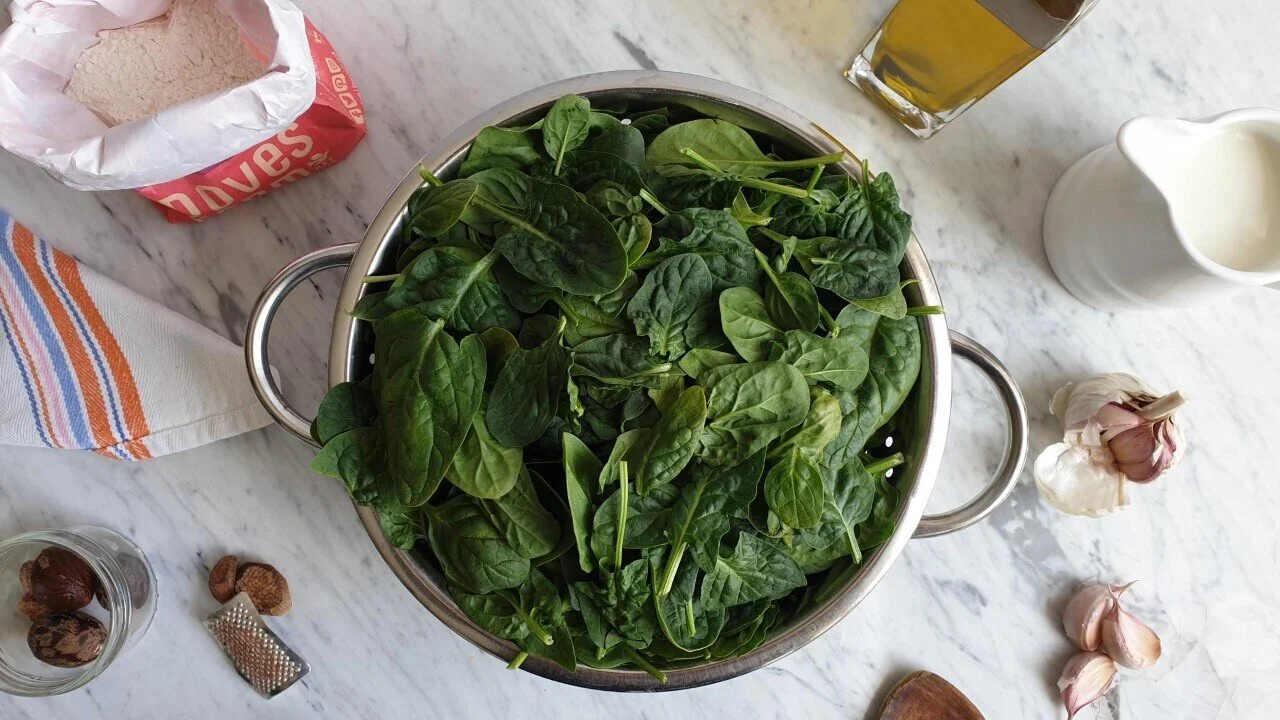
Wash thoroughly spinach or chard, (no need to do so if bought already washed version) cut off the stalks and chop or just tear the leafs with your hands into smaller pieces. If you are not using the stalks for this recipe you can use them for vegetable minestrone, put them on a compost or simply discard.

If using chard remove tough centre stalks.

View fullsize Spinach or chard with garlic and olive oil Istrian way 2.jpg
View fullsize Spinach or chard with garlic and olive oil Istrian way 3.jpg

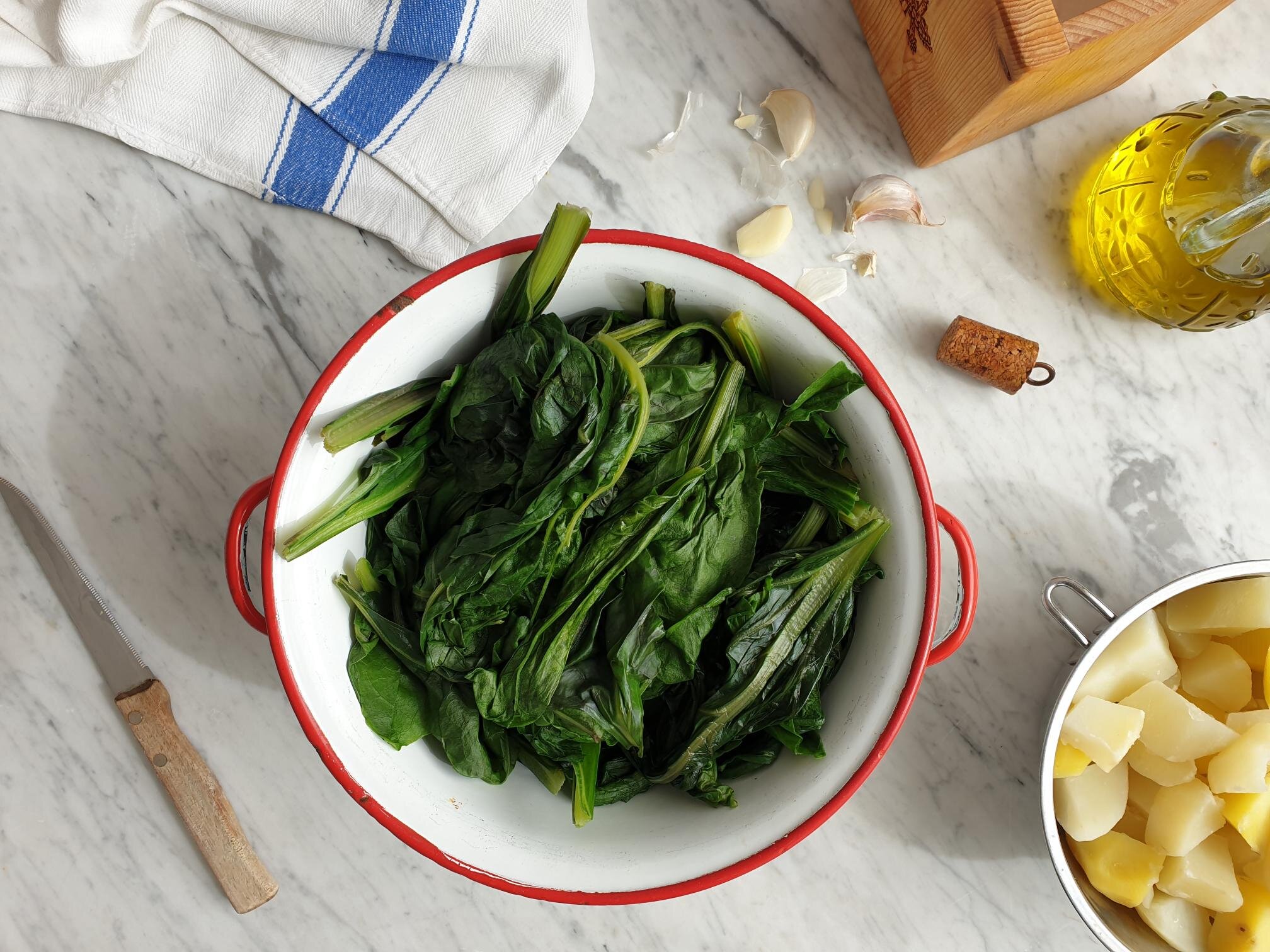
Place cubed potatoes in a pan, add water, a pinch of salt and boil until just tender, for about 10 minutes. Drain and set aside.

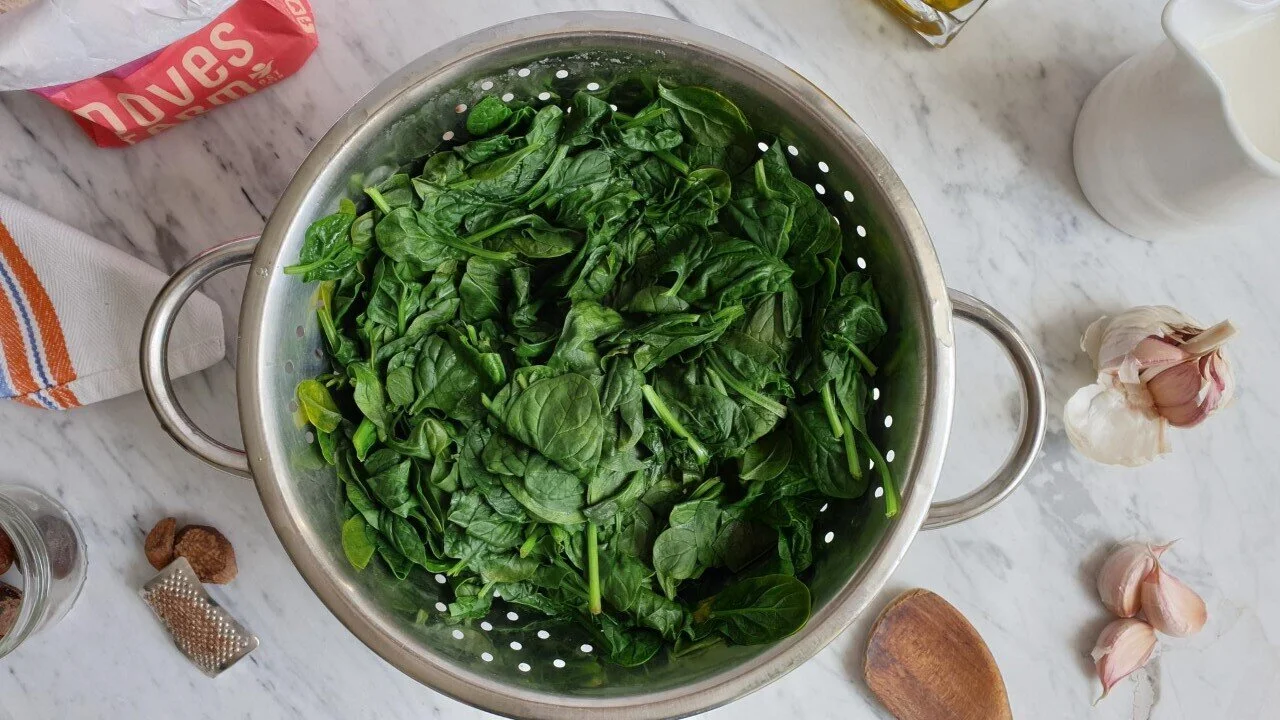
Fill a large pot with ¼ of hot water, add spinach or chard and cook only for few minutes until wilted.

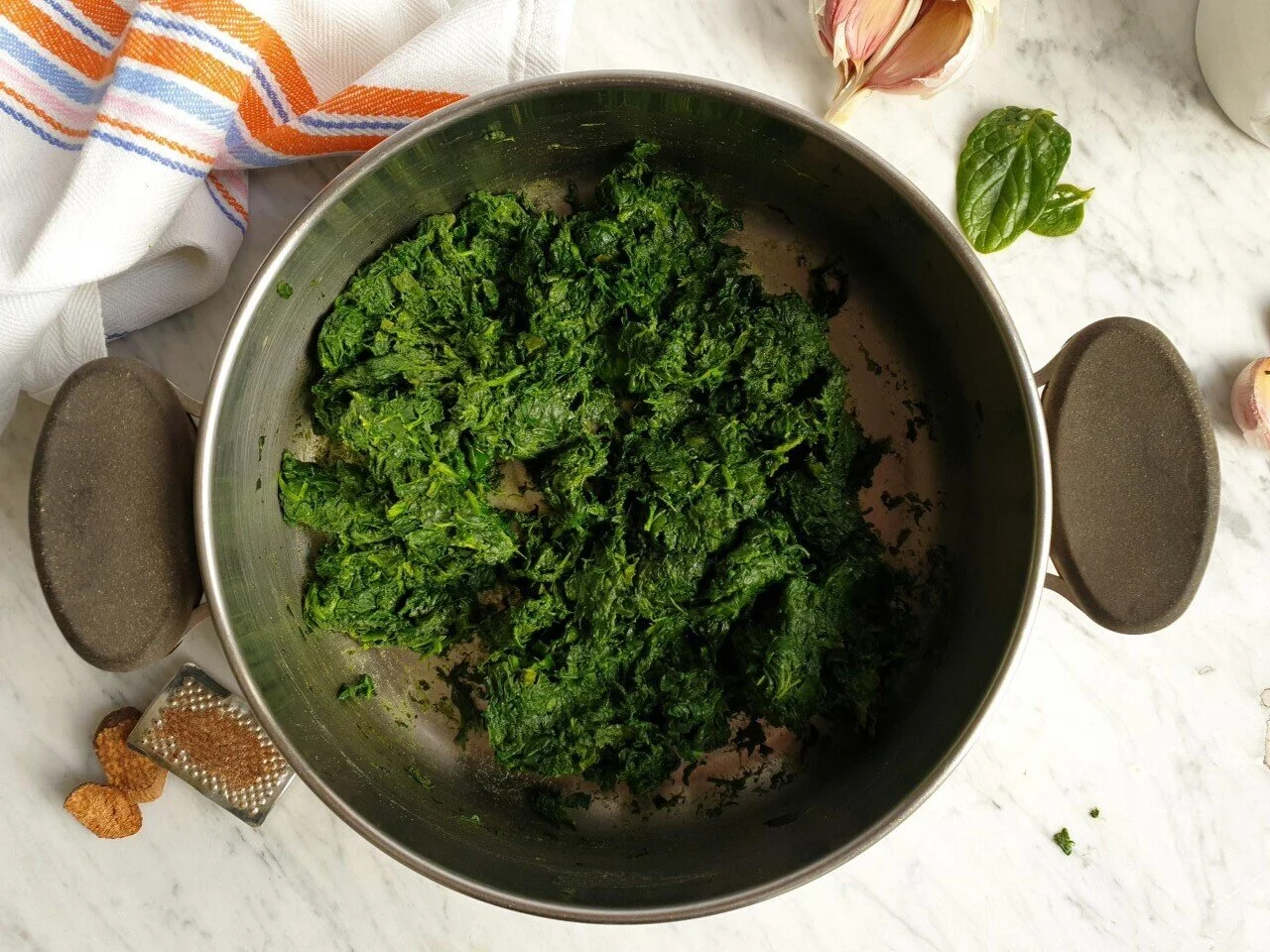
Drain very well in a colander. When the spinach is in a colander, press down with a back of a wooden spoon to remove a bit of excess water. You can use a big colander to drain both potatoes and chard.
Spinach or chard with garlic and olive oil Istrian way 4.jpg

Rinse quickly and dry the pot where you cooked the spinach, add extra virgin olive oil and garlic.

Fry the garlic on a gentle heat until it becomes softer and golden in colour. The oil will be nicely infused with the garlic.

Remove and discard the garlic.

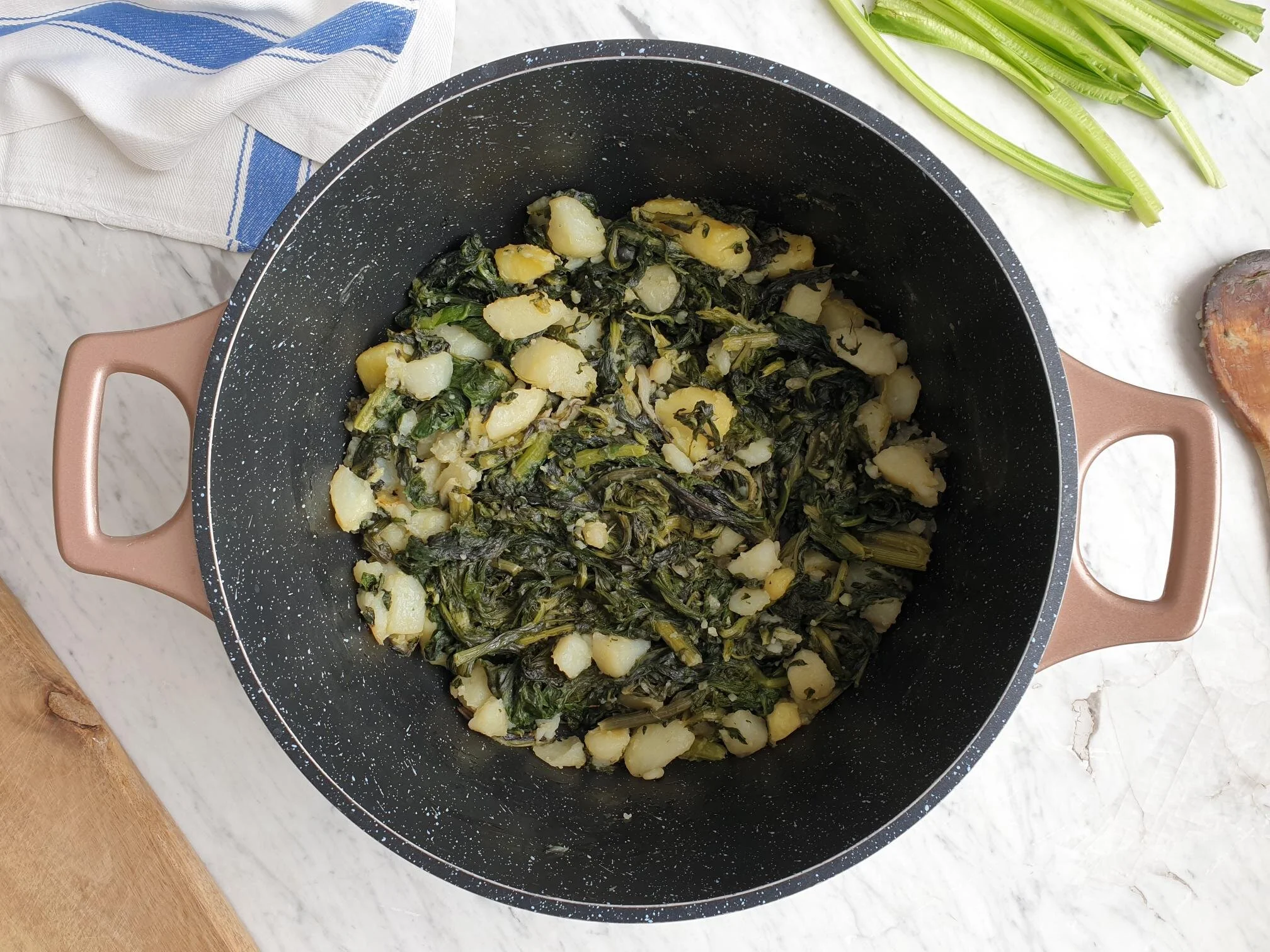
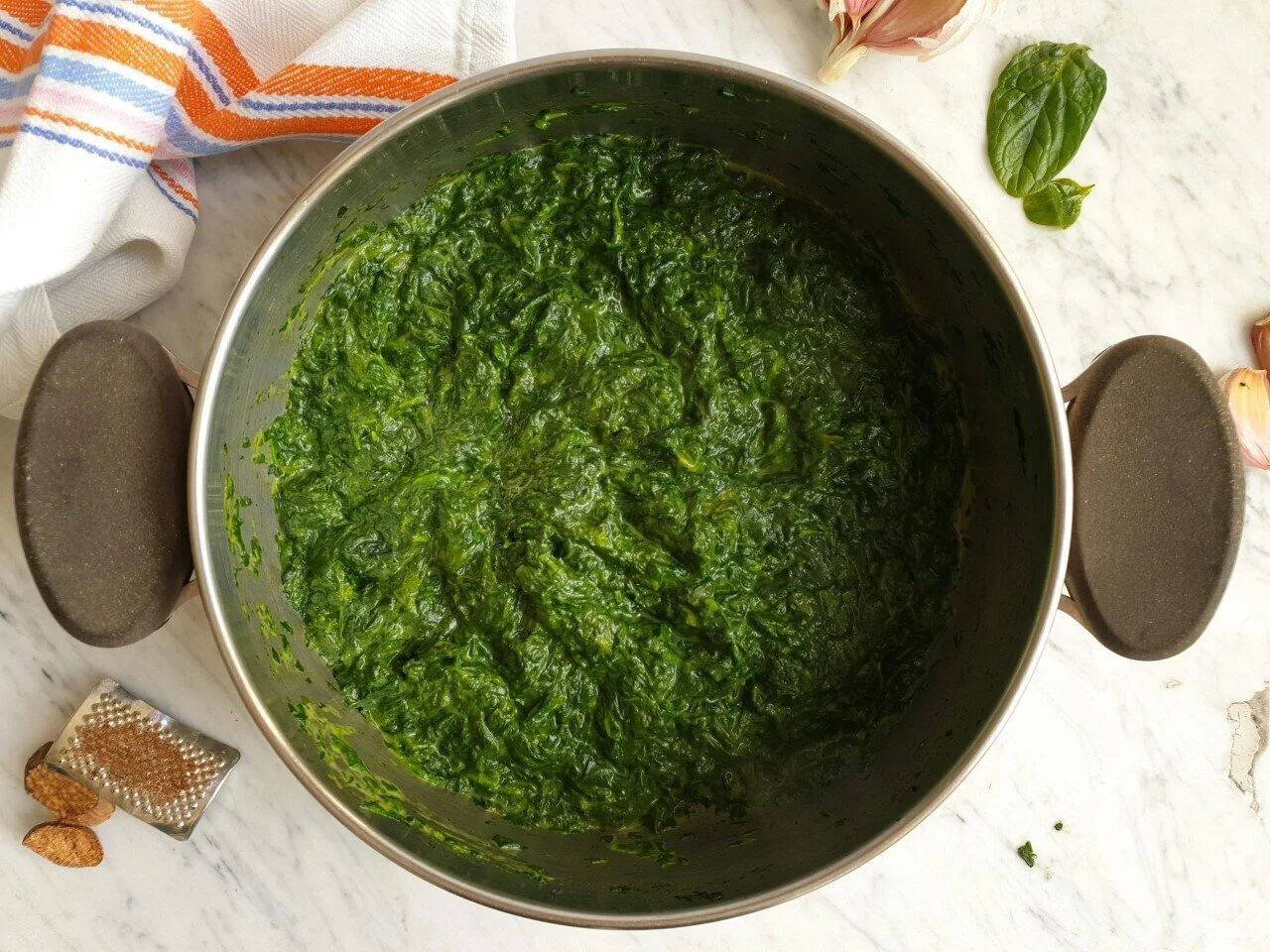
Add spinach and potatoes to the pan with garlic infused oil and sautéed on a medium heat for about 15 minutes, stirring occasionally or until you get a nice velvety consistency and you loose most of the water from the spinach.

Adjust the seasoning with sea salt and serve hot or at the room temperature.

View fullsize Spinach or chard with garlic and olive oil Istrian way 5.jpg
View fullsize Spinach and chard with garlic and olive oil 6.jpg

Just a thought

This vegetable side dish has a delicate garlicky flavour. If you are a big fan of garlic and keen on stronger garlicky taste, add crushed garlic to extra virgin olive oil without removing it instead of adding the whole garlic and removing it after the oil has been infused like suggested in the recipe.

You can also prepare this dish by cooking the potatoes and the spinach or chard in one big pot together rather then separately. Use one big pot, boil cubed potatoes first until just tender then add spinach or chard and cook until wilted, drain both in big colander.

October 02, 2021 /tina oblak
sautéed baby spinach with potatoes, easy spinach recipe, sautéed spinach with potatoes, fresh baby spinach, baby spinach in a skillet, quick spinach recipe, potatoes and spinach
Adriatic Recipe, brunch, Central European recipes, Easy recipe, healthy mael, Istrian cuisine, Istrian dish, Istrian food, Istrian gastronomy, Nutritious dish, Rustic dish, Side Dishes, Slovenian cuisine, Slovenian food, Slovenian gastronomy, Vegan, Vegetarian
Comment
Plum Dumplings 18.jpg

Plum Dumplings Recipe

Beans and Sardines
September 16, 2021 by tina oblak in Adriatic Recipe, Appetizers, breakfast, brunch, Central European recipes, dessert, dinner, Easter treats, Eastern European recipes, Easy recipe, entrée course, Istrian cuisine, Istrian dish, Istrian food, Istrian gastronomy, main course, main dish, Mitteleuropean recipes, pudding, Rustic dish, Slovenian cuisine, Slovenian food, Slovenian gastronomy, Starters, supper, sweet course, Sweet Things, Vegetarian, Dumplings

This is a great dish for Autumn that originated in the Austro-Hungarian Empire. It is made with potato gnocchi dough in which you stuff the plums, simmer them in water, and then coat them with breadcrumbs, sugar and cinnamon mixture.

These rustic plum dumplings will become a real treat in the family since they are super delicious and easy to make! This dish is traditionally offered as a dessert, however, it is very common as a main course for lunch or dinner.

Plum dumplings are very well known and common throughout the countries that were once part of the Austro-Hungarian Empire. This dish is therefore very popular in Eastern and Central Europe as well as in Trieste and the province of Trieste in Italy.

This historical influence made plum dumplings a very appreciated meal in Slovenia, and is referred to in Slovenian as češpljevi cmoki or slivovi cmoki (češplje and slive meaning plums and cmoki meaning dumplings). They are widely available to buy frozen in bags in the supermarkets, but nothing is comparable to making them at home with this simple recipe.

This dish is very familiar to me, I grew up with it, and it was prepared frequently in the late summer and early autumn when plums are in peak season, in abundance, and with the right level of sugar and sweetness in them.

In Slovenia, where I come from, plum trees are very common to have in the back garden or in a near by orchard and the sight of these beautiful, humble, bluish purple colour fruits, almost like jewels hanging from the branches, is simply heart warming. Plums are popular to use not only for plum dumplings but also for other desserts like bake trays, tarts, jams, and compotes.

Damsons plums, being oval and small, therefore easy to handle, are the preferred and most frequently used type of plums for this recipe. Other types of plums work very well too and fresh apricots are also used frequently to make the dumplings.

If you decide to offer plum dumplings as a dessert, I would suggest to serve 2, if you decide to prepare them as a main meal then 3 or 4 depending on the size.

Plum Dumplings 1.jpg

Ingredients

Serves 6- 8 (you will get about 16 dumplings)

Ingredients for the plum dumplings

  • 16 fresh plums, Damsons plums and prune plums most commonly used, you can use other variety (plums should be sweet, ripe and fairly firm to the touch, avoid overripe with soft pulp as it gets quite difficult and messy to pit them). You can use fresh apricots instead.

  • 1kg floury, yellow-fleshed potatoes, e.g. King Edward, Maris Piper, (avoid new potatoes). I use red skin potatoes.

  • 300g all purpose flour (plus extra for flouring the board and working surface)

  • 1 egg, slightly beaten

  • sea salt, a pinch

Ingredients for the breadcrumb coating

The ingredients stated here are to coat all the dumplings, if you wish to half the quantity of dumplings half the ingredients for the breadcrumb coating

  • 100g unsalted butter

  • 5 Tbsp natural dry breadcrumbs

  • 5 Tbsp caster sugar

  • 1 Tsp cinnamon

Method

Start this recipe by making a basic potato gnocchi dough. (For more details refer to my full step by step recipe for Potato gnocchi dough)

Wash the potatoes, with the skin on, under cold running water.

Place the potatoes in a saucepan or a pot, cover with cold water and bring to boil. After the water has come to a boil, cook for about 20 minutes or until tender. Cooking time will obviously vary depending on the size of the potatoes you are using.

Don't pierce them during cooking and don't overcook them allowing the skin to burst as they will absorb too much water, alternatively you can steam them.

Remove from the pot, drain them in a colander and let them cool enough to handle, then remove the skin. If the potatoes are still quite warm to handle, the best way to remove the skin is to stick the fork though the potato and peel it using a knife.

Put the flour on a working surface, add salt and mix with the fork.

Make a well in the middle and pass the potatoes through a potato ricer while still warm as they become stickier when cooler. Allow riced potatoes to cool for few minutes and then add the egg.

With your fingers work the flour into the potato and egg, bringing the dough together, until it becomes a soft, pliable dough and do not overwork it. If the dough is too sticky, wet and soft add a bit more flour. Make sure your working surface is always well floured.

When the dough is the right consistency it should not stick to your fingers.

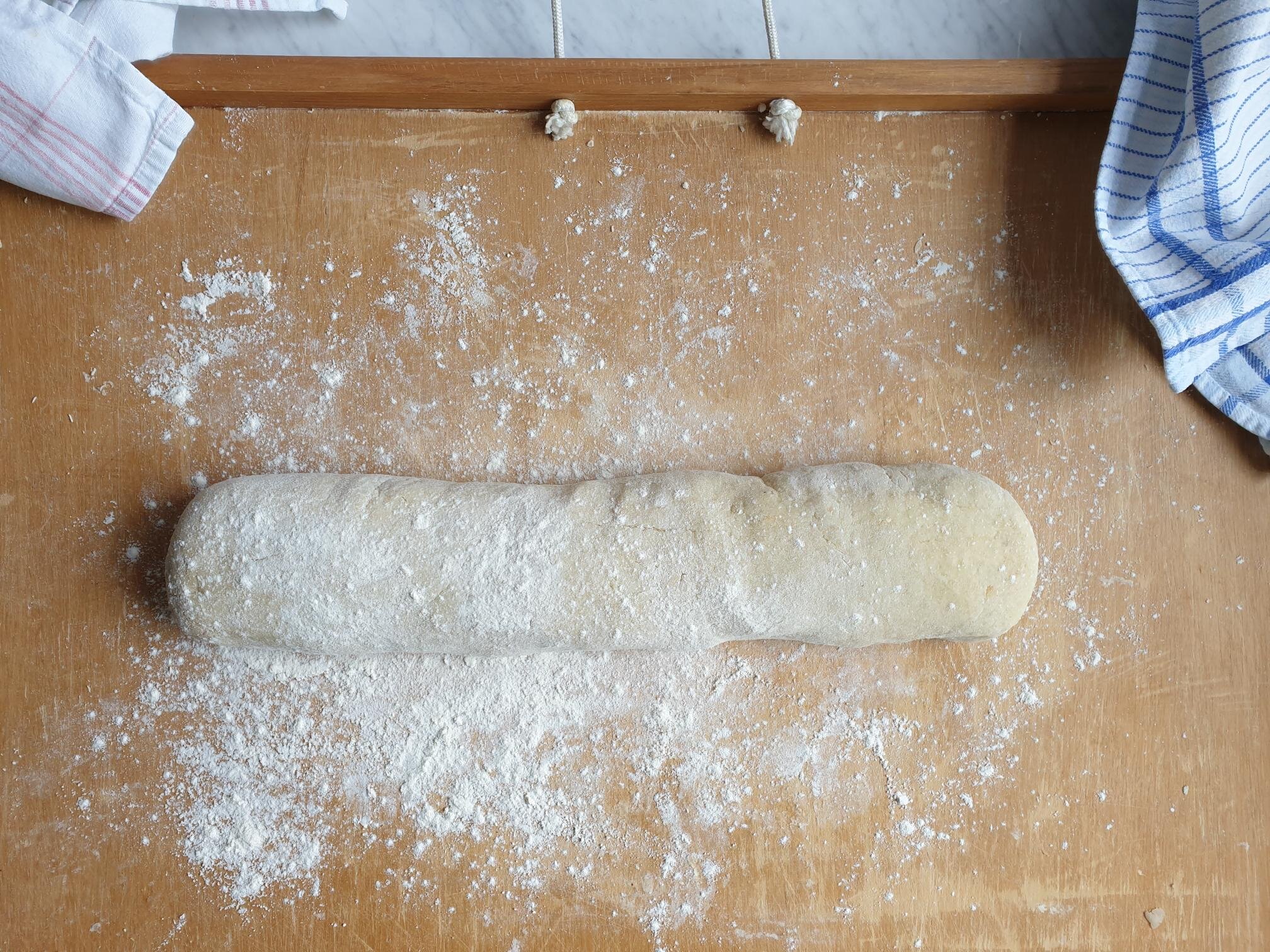
Shape the potato dough into a log.

Plum Dumplings 4.jpg

Prepare your plums by washing them and pat dry them. Then cut each plum lengthwise all the way round in order to get two halves and remove the pits.

View fullsize Plum Dumplings 2.jpg
View fullsize Plum Dumplings 3.jpg

Flour well your working surface and divide and cut the potato dough log roughly into 16 portions.

With your hands slightly floured, flatten and shape each portion into a round circle.

View fullsize Plum Dumplings 4a.jpg
View fullsize Plum Dumplings 5.jpg

Place one half of the plum in the centre and fill it with half Tsp of sugar, then place the other half of the plum on top of it.

If your plums are quite big in size, you might want to use only one half, as you will end up with very big dumplings which are more difficult to handle and not looking particularly elegant on a serving plate.

View fullsize Plum Dumplings 6.jpg
View fullsize Plum Dumpling 7.jpg

Wrap the dough tightly around the plums.

Seal the edges properly and tightly and shape it into a ball, roughly the size of a peach.

If the edges do not stick properly, dampen the edges with your fingers previously dipped in a bit of water, this will act a bit like a glue.

This step is quite important to prevent the dumplings from bursting and losing the juices during cooking.

Make sure you place each dumpling on a well floured surface to avoid sticking.

View fullsize Plum dumplings 8.jpg
View fullsize Plum Dumplings 9.jpg

It is quite crucial, when making dumplings, that you start and finish the process without interrupting for too long, as the sauce from inside the dumplings (the sugar inside the plum starts dissolving) will start leaking from the dumplings making it quite a mission to rescue them, and this is from the first hand experience!

Repeat the process until you use all the dough.

View fullsize Plum Dumplings 10.jpg
View fullsize Plum Dumplings 11.jpg
Plum Dumplings 12.jpg

Fill a large pot with water, add a generous pinch of salt and bring to boil.

Place gently each plum dumpling in a pot making sure they do not stick to the bottom.

Cook the plum dumplings in simmering water for about 12 minutes (not strong boiling as that can damage the dumplings).

They are fully cooked when they float on the surface.

While the plum dumplings are simmering, make the breadcrumbs sauce.

In a large pan, ideally non stick, melt gently the butter, add the breadcrumbs and toast for few minutes on a medium-low heat until slightly darker in colour.

Add sugar and cinnamon and mix until all the ingredients are well combined. Remove the pan from the heat to avoid burning the breadcrumbs mixture.

View fullsize Plum Dumplings 13.jpg
View fullsize Plum Dumplings 14.jpg

With a slotted spoon, remove plum dumplings from the simmering water.

Transfer them and place them in a pan with breadcrumbs mixture.

View fullsize Plum Dumplings 15.jpg
View fullsize Plum Dumplings 16.jpg

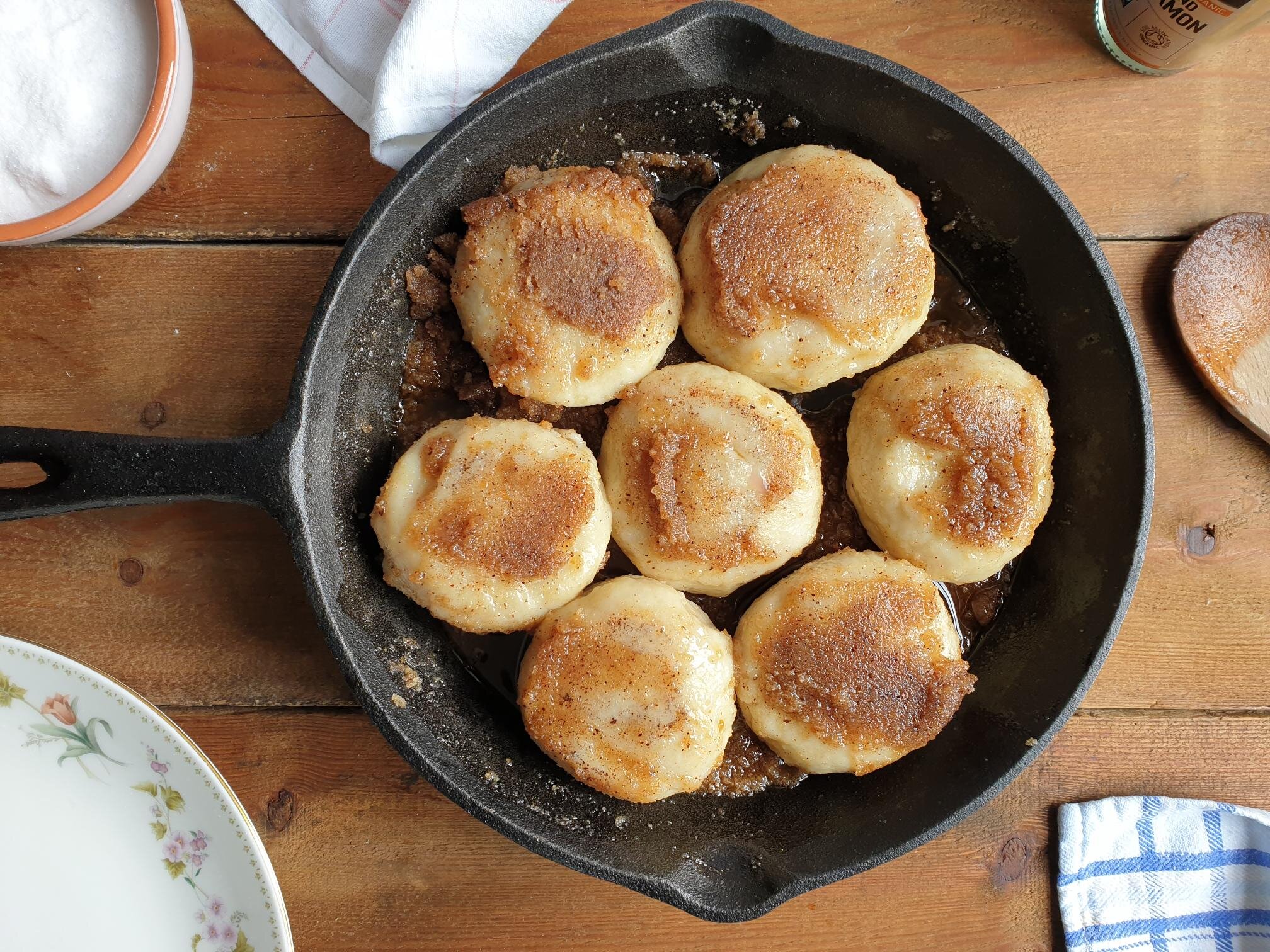
Shake the pan gently so the dumplings can roll around and get fully coated in the breadcrumbs mixture.

Plum Dumplings 17.jpg

Place on the serving plate, dust them with a bit of extra icing sugar and serve immediately. They are best eaten hot but equally delicious at room temperature.

Plum Dumplings 19.jpg

Just a thought

If you decide to only make half a batch of plum dumplings, you can use half of the potato dough for the plum dumplings and the other half for potato gnocchi. (see my full recipe step by step for potato gnocchi).

You can store cooked plum dumplings for up to three days in a airtight container.

If you need and desire to warm them up, putting them in a microwave is a good option as they retain the moisture.

The great thing about plum dumplings is also that they freeze very well. It is very important that you spread the uncooked dumplings in a single layer, leaving a bit of space between each dumpling, so they don't stick together, on a well floured wooden board, baking sheet, serving tray laid with baking parchment or with well floured kitchen cloth or similar.

Put the tray with the freshly made dumplings into a freezer, for at least 20- 30 minutes, and once frozen, put them into a freezing bag.

When you want to cook them just drop them frozen directly into a boiling salted water without defrosting them first, bearing in mind that the cooking time will be slightly longer, around 15 minutes. They are ready when they are floating on the surface.

Wine suggestion

Moscato Rosa delle Venezie IGT 2014 - Foffani

September 16, 2021 /tina oblak
Autumn Recipe, autumnal recipe, plums, plum puddings, plum desserts, potato gnocchi dough, češpljevi cmoki, slivovi cmoki, sweet dumplings
Adriatic Recipe, Appetizers, breakfast, brunch, Central European recipes, dessert, dinner, Easter treats, Eastern European recipes, Easy recipe, entrée course, Istrian cuisine, Istrian dish, Istrian food, Istrian gastronomy, main course, main dish, Mitteleuropean recipes, pudding, Rustic dish, Slovenian cuisine, Slovenian food, Slovenian gastronomy, Starters, supper, sweet course, Sweet Things, Vegetarian, Dumplings
Comment

Ćevapčići (Grilled Minced Meat Sausages of the Balkans) recipe

Beams and Sardines
July 13, 2021 by tina oblak in brunch, Central European recipes, dinner, Eastern European recipes, Easy recipe, Finger food, Istrian cuisine, Istrian dish, Istrian food, Istrian gastronomy, main course, main dish, main meat course, Meat, Mitteleuropean recipes, Slovenian cuisine, Slovenian food, Slovenian gastronomy, Small bites, supper, Balkan dish

Ćevapčići (plural and diminutive form of Ćevapčić) or Ćevapi (pronounced [ʨɛ'va:pi]) are small pieces of rolled grilled mince meat, type of Turkish kofte kebab, originally made in the Balkans during the Ottoman period. They are oriental in origin but can be traditionally found in the countries of what was formerly Yugoslavia, the Czech republic, Austria, Slovakia and the Italian province of Trieste and Gorizia.

Ćevapčići must be one of everyone's absolute favourite dishes back home in Slovenia and it is hard to imagine a barbecue without them. In fact, they are so popular, you can buy them ready made in almost every butcher shop or supermarket. They are popular street food (fast food) and became part of everyday diet in Slovenia. For meat lovers this little skinless sausages are a real dream.

As a child I have very vivid memories of going to a skiing holiday to a capital of Bosnia and Herzegovina, Sarajevo, and having the best ever, and I mean the best ever Ćevapčići in Baščaršija which is Sarajevo's old bazaar and the historical and cultural centre of the city. I was utterly fascinated by the place being so different from my native small Venetian looking coastal town of Koper. That was the first time I saw a real mosque and was captured by the beautiful Ottoman architecture.

Ćevapčići are grilled and served as a main course in groups of five to ten pieces on a plate or in a lepinja (traditional flatbread). They are commonly eaten with Ajvar (cream of roasted red peppers), chips, flat breads, pieces of spring onions or thinly sliced yellow or white onions and kajmak (type of cream cheese). What accompanies really well this dish is a fresh salad of tomatoes, cucumber, onions and any feta type of cheese, it completes the meal well.

I currently live in England where I cannot buy ready made Ćevapčići so I have decided to make them fresh from scratch, there is a great sense of satisfaction as you can tweak the ingredients to your taste.

The main ingredient is mince meat, lamb, veal pork or beef, you can mix two or three types of minced meat and there could be a variation of meat content and seasoning.

I am sharing here my father's recipe, he used to love Ćevapčići and he loved preparing them for the family.

Ingredients

Serves 4

  • 500g mince lamb

  • 500g mince beef (can use 250g of mince beef and 250g of mince pork)

  • 60g unsmoked pancetta or bacon, cut in small pieces (can use smoked alternative if prefer)

  • 180g roughly of onions (very finely chopped)

  • 1-2 clove of garlic (pressed)

  • 1 egg (slightly beaten)

  • 1 Tbsp powdered Hungarian sweet paprika

  • ¼ Tsp baking soda

  • sunflower oil for brushing

  • sea salt

  • black pepper (freshly ground)

Method

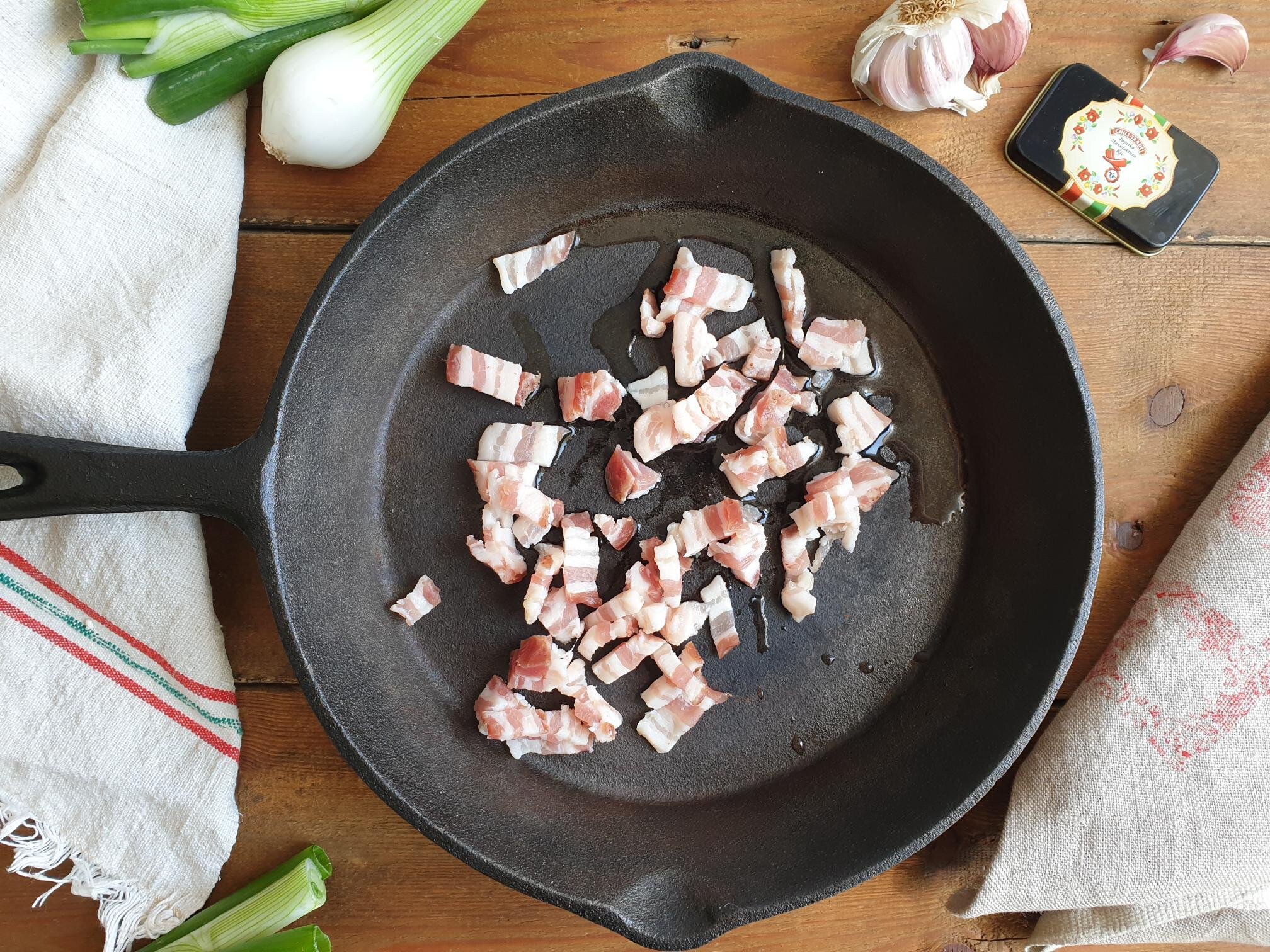
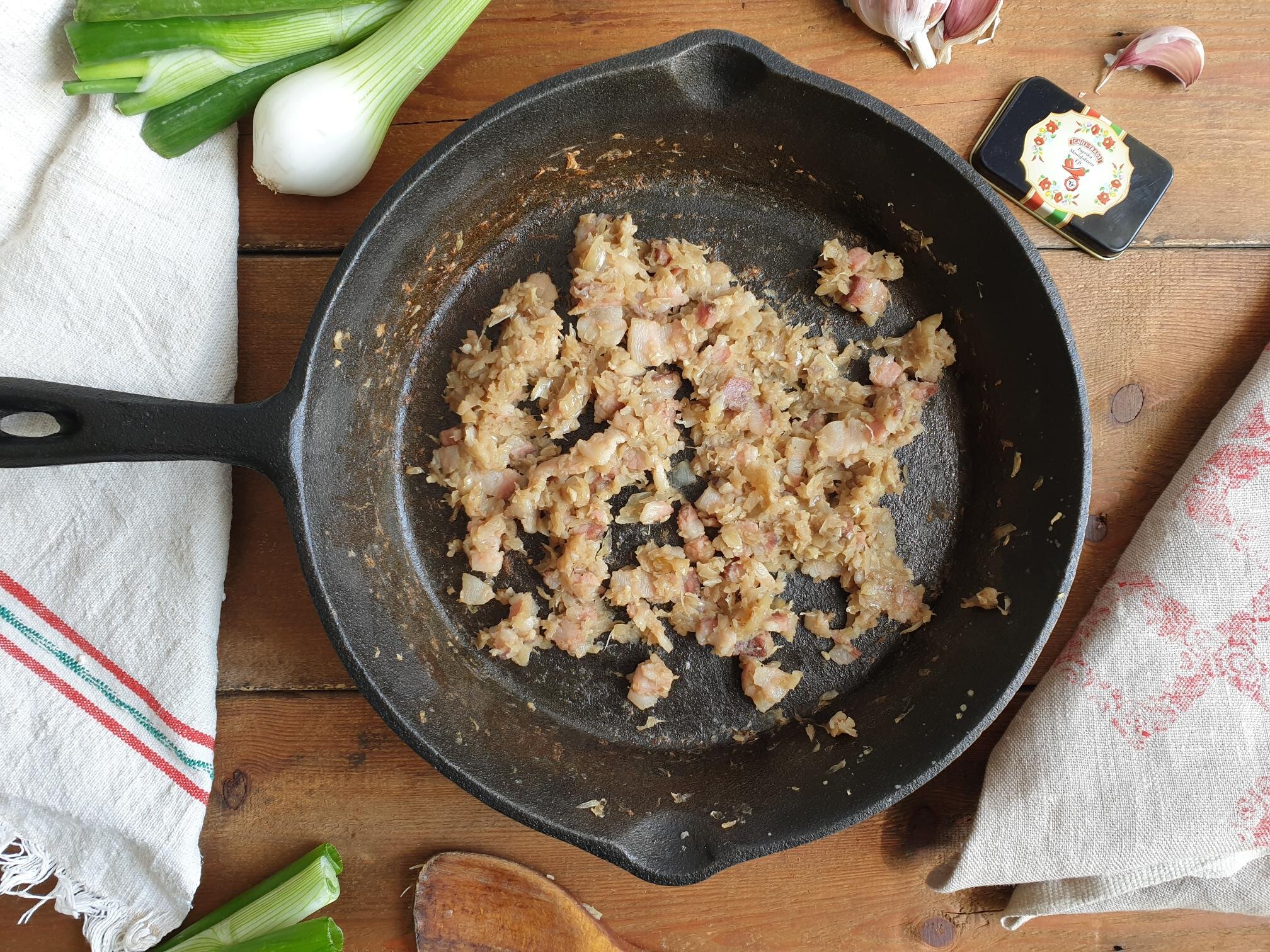
Put a table spoon of water in a frying pan and sautée on a medium heat pieces of pancetta or bacon. Turn the heat down, add the onions, garlic, a pinch of salt and fry gently, stirring frequently, until they become golden in colour and soft. It should take 10-15min, then set aside and cool.

View fullsize Cevapcici 2.jpg
View fullsize Cevapcici 3.jpg
View fullsize Cevapcici 4.jpg

Transfer the pancetta/bacon and onion mixture into a food processor, add mince meat and mix at a low speed. Pulse if you can, as you do not want a completely smooth paste but a mixture with still a bit of a texture. If you have a smaller food processor you might have to do this in batches.

View fullsize Cevapcici 5.jpg
View fullsize Cevapcici 6.jpg

Transfer the mixture from the food processor into a big bowl. Add the egg, pinch of salt, black pepper, baking soda and sweet paprika. With your hands mix well to combine all the ingredients, no food processor will do better job!

View fullsize Cevapcici 6a.jpg
View fullsize Cevapcici 6b.jpg
View fullsize Cevapcici 7.jpg

Take a size of a golf ball, weighing roughly between 30-40g and shape into small sausages of about 7-8cm long.

Place your Ćevapčići onto a big plate or a tray and refrigerate for about 1hour.

Ćevapčići are ideal for barbecuing but as this is not always possible you can cook them in a grill pan.

Barbecue or grill the Ćevapčići on the hot grill pan for about 14 minutes, turning them often in between. They are ready when nice and brown on the outside and cooked through. It might be a good idea to check by cutting one in the middle. In this way you can calculate the grilling time for the following batches.

No matter which way you choose to cook them, make sure you lightly brush them with oil during the cooking process and try not over cook them as they will go hard.

View fullsize Cevapcici 9.jpg
View fullsize Cevapcici 10.jpg

Just a thought

Ćevapčići freeze well, just make sure you freeze them individually first on a plate or a tray to avoid them sticking to each other, and then place them in a freezing bag...... and you are all set for your next BBQ outside with friends or family, or for an enjoyable meal indoors!

Wine suggestion

Carso-Kras DOC "Terra Rossa" 2009 by Branko & Vasja Čotar, Carso-Kras

July 13, 2021 /tina oblak
mince pork, mince beef, mince lamb, grilled meat, grilled sausages, BBQ, Ćevapčići, Grilled Minced Sausages of the Balkans
brunch, Central European recipes, dinner, Eastern European recipes, Easy recipe, Finger food, Istrian cuisine, Istrian dish, Istrian food, Istrian gastronomy, main course, main dish, main meat course, Meat, Mitteleuropean recipes, Slovenian cuisine, Slovenian food, Slovenian gastronomy, Small bites, supper, Balkan dish
1 Comment
Frittata with dry sausage 1.jpg

Frittata with dry sausage (salami) recipe

Beans and Sardines
June 01, 2021 by tina oblak in Adriatic Recipe, Appetizers, breakfast, brunch, Canapés, Central European recipes, entrée course, Finger food, Istrian cuisine, Istrian dish, Istrian food, Istrian gastronomy, main course, main dish, Rustic dish, Slovenian cuisine, Slovenian food, Slovenian gastronomy, Small bites, Snacks, dinner, supper

Frittata with dry sausage is a quick and easy midweek lunch or dinner and a great weekend breakfast or brunch option. Fantastic eaten hot but often served at room temperature and perfect to make ahead for picnics and larger groups. Serve it with rustic bread or polenta and a salad. Great also as a sandwich filling.

To me, however, this simple dish is more than just a quick meal solution.

Both my grandfathers loved frittatas, and not without a glass of red wine! They would normally have it upon the return back home late morning after working in the allotments or in the olive grove.

My paternal grandfather really liked dry sausage frittata while my maternal grandfather was really keen on wild fresh herbs frittata but both really liked wild asparagus and pancetta (or without) variation. All three typical in the region.

This simple dish, similar to an omelette, is Italian in origin (frittata is an Italian word and roughly translates to “fried”) but due to such a close geographical proximity to Italy, frittata found a huge popularity in a local cuisine and could be referred to as Fritaja s klobasami – Fritata or Frtalja s klobasami and Fritaia con le luganiche in Istrian dialect. All these names come from the Venetian word fritaia.

Amazingly, this simple frittata with dry sausage, is a speciality in Istria and also has a deep meaning in a local folklore. This type of frittata is typically made especially during Carnival period (festive season that occurs before the liturgical season of Lent). In rural areas and particularly in small villages locals dressed up in different Carnival costumes. In groups they would walk from house to house singing traditional folk songs accompanied by sound and the melodies of the accordion, usually played by one member of the group.

As a sign of appreciation for entertaining and lifting the spirits, they received food gifts which consisted of fresh eggs, dry sausages, salami, crostoli, fritole (typical Carnival sweet things) and also wine.

When this simple Carnival procession was over, the participants would gather in somebody's home and frittata with dry sausage was made and other dishes were prepared with everything they received.

All the food was displayed on the table, shared and enjoyed, often ending up in excessive consumption of alcohol and other foods that will be forgone during upcoming Lent. There was a lot of singing and dancing, this is how local people came together and enjoyed each other company, the festive period and the the end of harsh winter.

My nona Nada also shared with me a lovely story, telling me that this festive season also provided the opportunity for young men and women to casually meet and possibly fall in love...

Frittata with dry sausage 2.jpg

Ingredients

Serves 4

  • Italian dry sausage/salami (about 150g), can use French sausage (saucisson), Spanish Chorizo (the important thing is that they are not too dry and hard, when buying should feel a bit soft when squeezing)

  • 6 eggs, beaten or whisked

  • 1 Tbsp extra virgin olive oil

  • sea salt, to taste (bear in mind the sausages are dry cured and taste salty already)

  • black pepper, freshly ground (to taste)

Method

Peel the dry sausage, place it on a chopping board, slice it, half it and then cut it into quarters.

View fullsize Frittata with dry sausage 3.jpg
View fullsize Frittata with dry sausage 4.jpg

In a separate bowl whisk the eggs and season with salt and pepper.

Frittata with dry sausage 5.jpg

Put the oil in a skillet, ideally non stick, and heat it.

Sauté and lightly sear the sausage on a medium high heat stirring frequently.

Frittata with dry sausage 6.jpg

Pour the egg mixture in the skillet over the sausage, turn the heat to fairly low and cover with the lid (glass lid with steam hole works very well, if you have it). Also, using a slightly bigger lid than the skillet will help to keep the frittata “dry”. Lid that fits perfectly on top of the skillet could potentially trap quite a bit of steam and possibly making your frittata a bit wet.

The use of the lid will also help to cook the frittata evenly, avoiding the bottom of frittata being almost burnt and the egg mixture on the top being still raw, runny and unset.

Cook the frittata for about 20 min. The frittata is cooked when the underside is set and the egg mixture on the top no longer runny.

Frittata with dry sausage - Recipe.jpg

Just a thought

In this recipe, I have chosen to cook the frittata on the stove with a lid as my family has always used this method. I have also bear in mind that not everyone has a skillet that can go in the hot oven or under the grill.

However, if you are familiar cooking the frittata in the oven, and that is your preferred method, it is perfectly fine to do so.

Wine suggestion

Refosco dal Peduncolo Rosso IGT 2017 by Vigna Petrussa, Venezia Giulia.

June 01, 2021 /tina oblak
Italian salami, dry sausage, chorizo sausage, french sausage, saucisson, fresh eggs, frittata, Istrian frttata, Fritaja s klobasami
Adriatic Recipe, Appetizers, breakfast, brunch, Canapés, Central European recipes, entrée course, Finger food, Istrian cuisine, Istrian dish, Istrian food, Istrian gastronomy, main course, main dish, Rustic dish, Slovenian cuisine, Slovenian food, Slovenian gastronomy, Small bites, Snacks, dinner, supper
Comment
Creamed spinach 1.jpg

My mum's Creamed spinach (without cream) recipe

Beans and Sardines
May 25, 2021 by tina oblak in Adriatic Recipe, brunch, Central European recipes, Eastern European recipes, Easy recipe, healthy mael, Istrian cuisine, Istrian dish, Istrian food, Istrian gastronomy, Nutritious dish, Rustic dish, Slovenian cuisine, Slovenian food, Slovenian gastronomy, Vegetarian

Creamed spinach is one of my absolute favourite side dishes and it is one of those recipes that you will go back to time and time again. Spinach is a beautiful leafy plant but it is sometimes an unsung hero of dinner greens. It is quick and easy to make, perfect to introduce as a vegetable dish during midweek or to serve along those special weekend meat roasts. It is very tasty, nutritious, healthy and accompanies really nicely just about any fish or meat dish.

Spinach cooked this way was the one I loved most as a child, and I could never get enough of it, I could literally eat it out of pan with a spoon, nothing much has changed. And of course, I was never told off for eating too much of it! Definitely worth giving it a go if you have children (and adults) that are not so kin on vegetables.

My mother made creamed spinach very often for me and my brother when we were little during the week as a quick meal together with mashed potatoes and fried egg. This vegetable side dish is very popular back home and still served as part of school meals just as it used to be. It is reassuring to know that some things just haven't changed...

Creamed spinach 2.jpg

Ingredients

Serves 2-4 as part of meal

  • 2 Tbsp extra virgin olive oil

  • 1 clove of garlic, peeled

  • 500g of baby spinach (washed and ready to use) You can use other varieties of spinach or Swiss chard in which case you remove the stalks

  • 2 Tbsp all-purpose flour

  • 250 ml milk (semi skimmed or full fat)

  • sea salt

  • nutmeg, freshly grated (optional)

Method

First of all you need to wash the spinach thoroughly if you bought it unwashed. If you are using the spinach that has been washed already and is ready to use just skip the following step.

The best way to wash the spinach is to put it in a sink or large container of cold water. Swish leaves around and than let them stand for a few minutes allowing the dirt to sink to the bottom.

Place washed spinach in a big pot and pour over boiling hot water. If you prefer you can bring a large pot of water to a rolling boil and then add the spinach. In both cases you need to push the leaves down to completely submerge them in the water.

Blanch the spinach for about 40 seconds to a minute (blanching is most often used as an intermediary step for a dish and it means giving greens, in this case spinach, a quick cook in hot water to cook them through and soften them).

Place a large colander in a sink, drain the spinach and run it under cold water just for few seconds. This will stop the cooking immediately (and retain the nutrients) but it will also help to cool down the spinach.

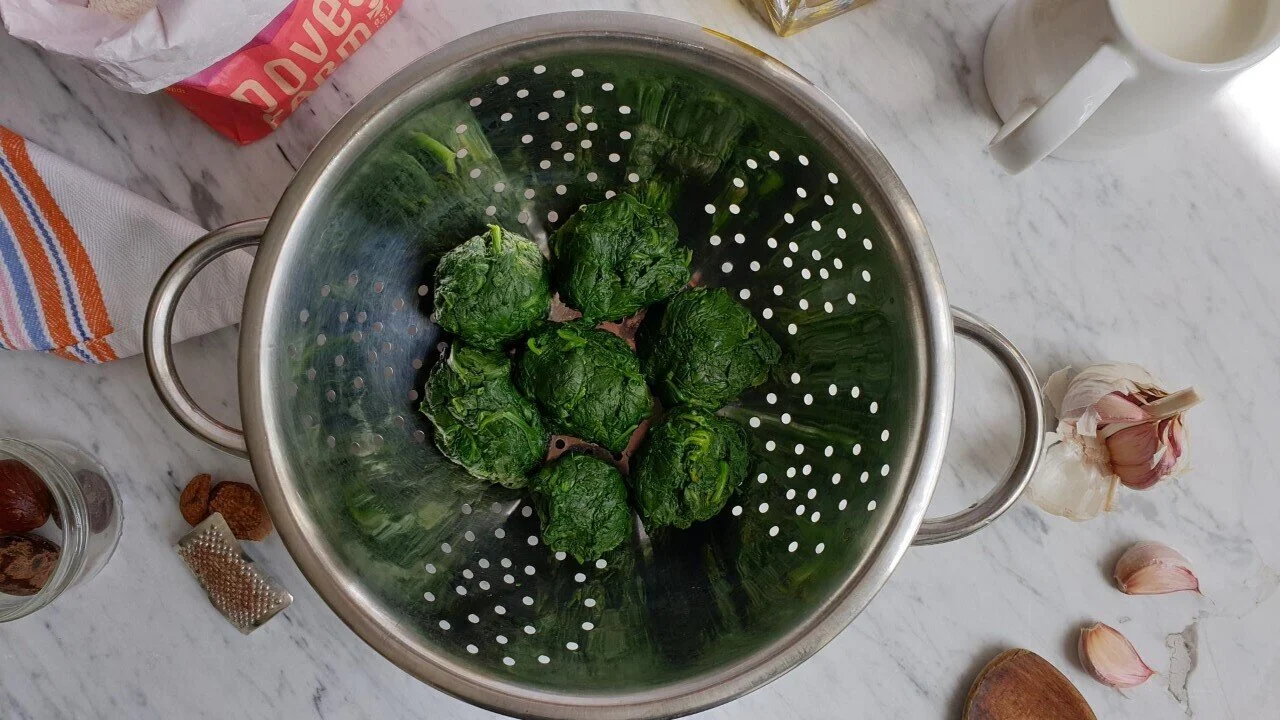
Let the spinach cool completely for few minutes and drain as much as you can. You want to remove as much excess liquid as you can (spinach contains quite a lot of water). I do this in batches by taking small handfuls of spinach and squeeze it very well. I end up with few balls of very well drained spinach.

View fullsize Creamed spinach 3.jpg
View fullsize Creamed spinach 4.jpg

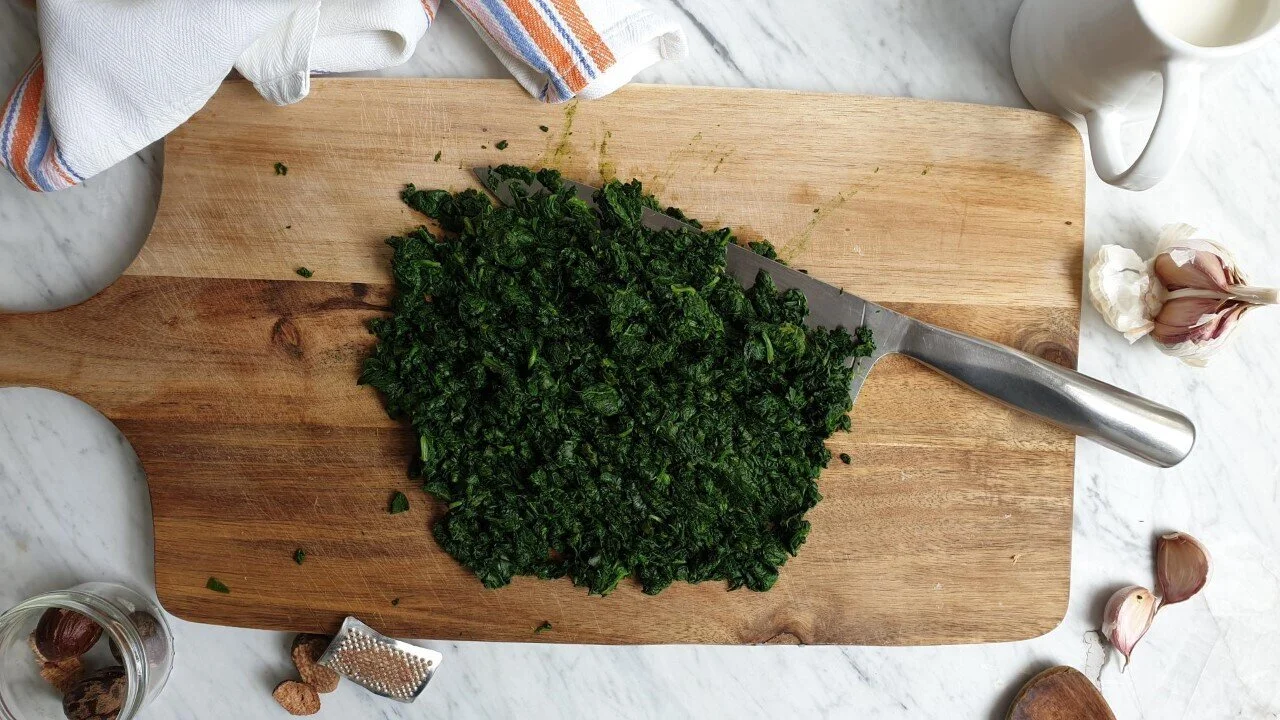
Transfer drained spinach on a chopping board and chop quite finely.

Creamed spinach 5.jpg

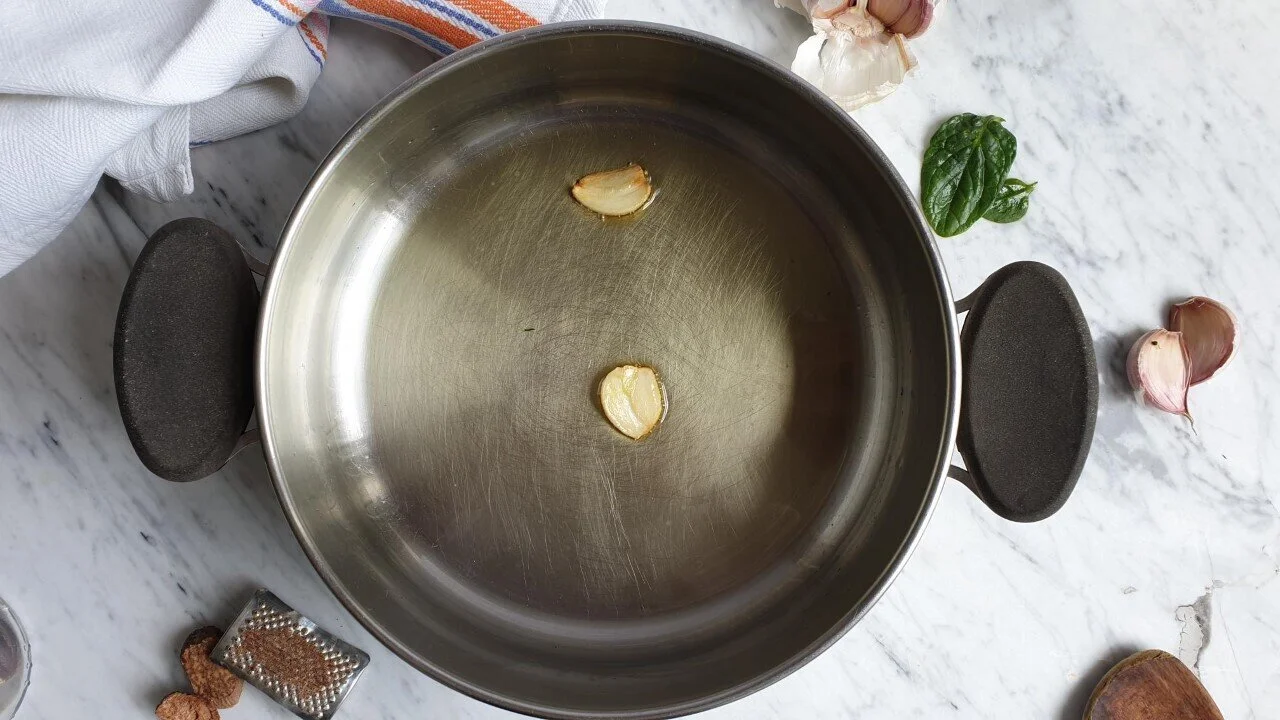
Put the extra virgin olive oil and peeled clove of garlic in a saucepan. Infuse the oil with the garlic on a medium-low heat and when the garlic turns nice golden colour remove it from the saucepan and discard it. Be careful not to burn it, trust me this is easily done.

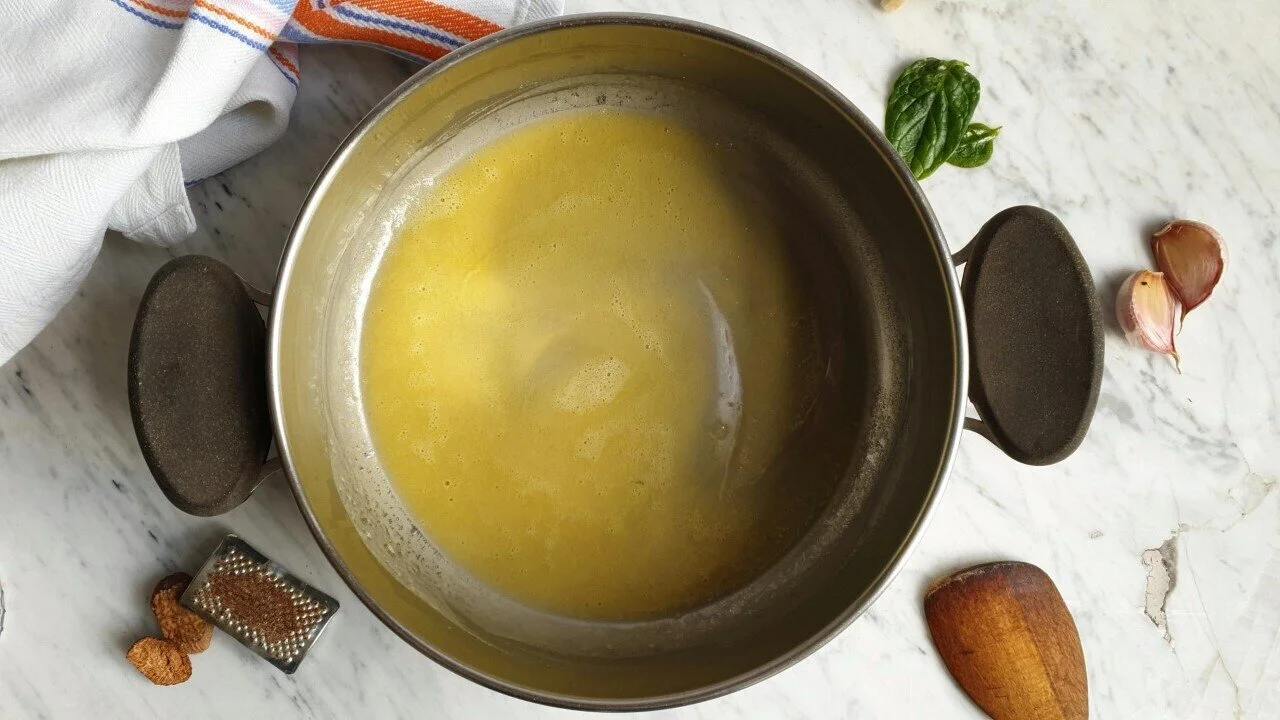
Add the flour and cook briefly, stirring constantly, until the flour turns golden colour.

View fullsize Creamed spinach 6.jpg
View fullsize Creamed spinach 7.jpg

Add chopped spinach and stir well so the spinach is mixed well with the flour mixture. At this point the spinach mixture might stick to the bottom a bit, do not worry if this is the case.

Start pouring gradually the milk, stirring and mixing constantly, incorporating well. Season with salt and add some freshly grated nutmeg, if using, and cook further for about 5-7 minutes on a gentle heat, stirring constantly. By this time you should end up with a lovely thickened creamed spinach. If it does look a bit watery give it another minute or so.

View fullsize Creamed spinach 8.jpg
View fullsize Creamed spinach 9.jpg

Just a thought

If you prepare this dish in advance it might get a bit thick. When heating up just pour in gradually a little bit more milk and stir constantly until you get the desired consistency.

Creamed spinach 10.jpg
May 25, 2021 /tina oblak
fresh baby spinach, baby spinach in a skillet, quick spinach recipe, easy spinach recipe
Adriatic Recipe, brunch, Central European recipes, Eastern European recipes, Easy recipe, healthy mael, Istrian cuisine, Istrian dish, Istrian food, Istrian gastronomy, Nutritious dish, Rustic dish, Slovenian cuisine, Slovenian food, Slovenian gastronomy, Vegetarian
3 Comments
LRM_20191009_123138.jpg

Liptauer (Austro-Hungarian paprika spiced cheese spread) recipe

Beans and Sardines
March 09, 2021 by tina oblak in Starters, brunch, Easy recipe, entrée course, healthy mael, Slovenian cuisine, Slovenian food, Slovenian gastronomy, Vegetarian, spreads, Eastern European recipes, Central European recipes, Mitteleuropean recipes, Snacks, Canapés, Finger food, Small bites, Appetizers

Liptauer, pronounced “Lip-tower”, is a simple, flavourful, central European, or Mitteleuropean, well seasoned, paprika spiced cheese spread with a sharp, rich, and deep smoky taste.

Its origin has long been disputed but the name derived from the German name Liptau for the region of Liptov (Hungarian: 'Lipto') in northern Slovakia, a former county in the Austro-Hungarian Empire.

Nowadays, Liptauer spread appears in numerous variations throughout many other European countries, and is a part of Slovak, Hungarian, Slovenian, Italian (some north-east regions) and Austrian cuisine, where it is commonly served as a popular dish in wine taverns, and as a snack for kids during break time in schools.

Despite extensive variations on the recipe, as many families have their own unique version of Liptauer, they all have in common the main ingredient which is cheese that can vary from Quark, Bryndza (a sheep milk cheese) cream cheese, cottage or goat cheese and powdered sweet paprika giving a spread a beautiful colour.

It is great for vegetarians and you can change and play around with the quantities of some ingredients to suit your taste.

Here, I will share with you the recipe my maternal Grandma Iva used to make. This dish was a constant part of my childhood and it really does bring back some wonderful memories as it was made on numerous occasions, especially when the family got together to mark special festivals like Carnival (before Lent began), Easter, Christmas, and All Saint's Day, or family celebrations like birthdays and anniversaries.

LRM_20191009_123656 (1).jpg

My grandmother would put the spread in the middle of the table with freshly made home made bread, and everyone would help themselves before the big meal ahead. Along with the spread, there would be a selection of cold meats, different types of cheeses, and a variety of pickles. We children often got so stuffed with this delicacy we did not get to the first course! We just simply could not resist the fresh spread on a crunchy piece of bread. It is a great appetizer from Mitteleuropa to start the children on!

LRM_20191009_115935.jpg

Liptauer has a very versatile use. Traditionally served as part of cheese and charcuterie board and hard boiled eggs.

It is typically eaten as an open sandwich, or on toast, crackers and bagels. It is a great alternative base for a variety of sandwiches, and can be used as canapè spread.

You can serve it with drinks, pretzels, and a selection of pickles, cheese sticks, and really whatever you fancy.

I also serve them as a canapè with drinks, and they do go down as a real treat. Just take a single round of thinly sliced piece of German or Hungarian style salami, spread a bit of Liptauer and roll it into a cigar shape. And there you have it, salami roll ups.

LRM_20191015_110326.jpg

Ingredients

  • 250g curd cheese (was difficult to find, now available in most supermarkets and Polish food stores)

  • 50g butter (soft at room temperature)

  • 1 Tsp Dijon mustard

  • 1 Tsp powdered sweet Hungarian paprika

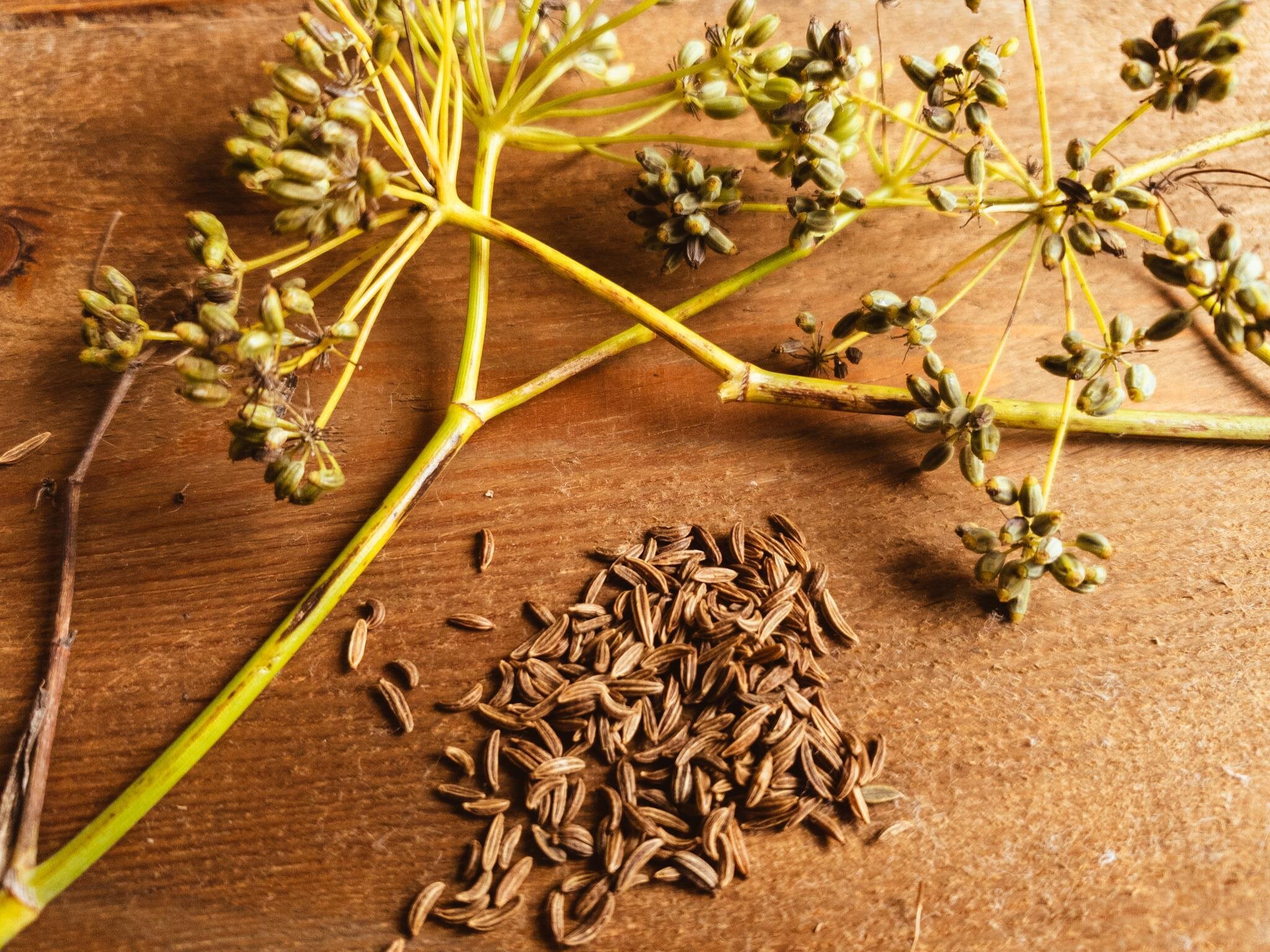
  • 1 Tsp caraway seeds (crashed well with pestle and mortar)

  • 2 Tbsp pickled gherkins, cornichons or pickled cucumber (very finely chopped)

  • 2 Tbsp onions (very finely chopped)

  • sea salt, a pinch or to taste

  • freshly ground black pepper, a pinch or to taste

View fullsize LRM_20191008_110825.jpg
View fullsize LRM_20191008_135836.jpg

Method

Put all the ingredients in a bowl. Mix and combine well all the ingredients. Serve as a cold starter.

LRM_20191009_103405.jpg

You can keep the spread in the fridge for up to a week in an airtight container.

Just a thought

This is a great cold starter. If you can, try to prepare it in advance, and ahead of a time to allow all the ingredients and flavours to absorb well.

Wine suggestion

Traminer Aromatico DOC 2019 by Sirch, Friuli Colli Orientali.

March 09, 2021 /tina oblak
Sweet Hungarian paprika, Liptauer (Austro-Hungarian paprika spiced cheese spread) recipe, Austro-Hungarian paprika spiced cheese spread recipe, Liptauer spread, Eastern European cheese spreads, Eastern European cheese spread, sandwich spread, canapé spread, vegetarian curd cheese spread, Liptauer
Starters, brunch, Easy recipe, entrée course, healthy mael, Slovenian cuisine, Slovenian food, Slovenian gastronomy, Vegetarian, spreads, Eastern European recipes, Central European recipes, Mitteleuropean recipes, Snacks, Canapés, Finger food, Small bites, Appetizers
1 Comment
  • Newer
  • Older